Iranian Journal of Field Crops Research

Iranian Journal of Field Crops Research

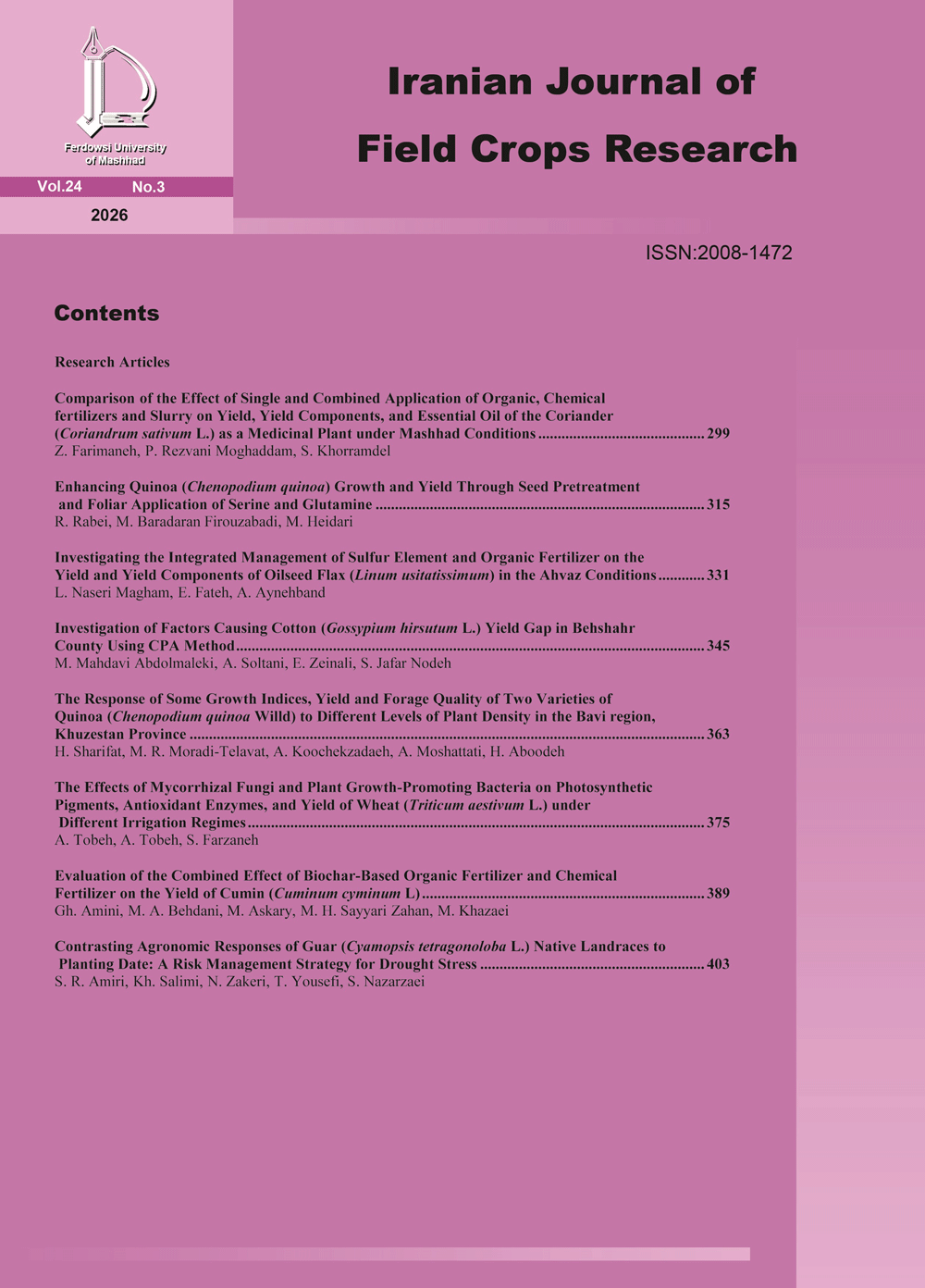
Investigating the Integrated Management of Sulfur Element and Organic Fertilizer on the Yield and Yield Components of Oilseed Flax (Linum usitatissimum) in the Ahvaz Conditions

Document Type : Research Article

Authors
Department of Plant Production and Genetics, Faculty of Agriculture, Shahid Chamran University of Ahvaz, Ahvaz, Iran
Abstract
Introduction
Flax (Linum usitatissimum) is an annual plant with a stem height of 30 to 50 centimeters. Unlike fiber flax, oil flax has a stem with several branches. Oil flax seeds contain 22% protein, 6.5% crude fiber and 30 to 40% oil. They are of particular importance due to the presence of some essential amino acids such as lecithin 3.8%, methionine 2.3% and tryptophan 1.9%. One way to increase flax yield is to apply agronomic management practices such as appropriate planting date and optimal nutrient intake. On the other hand, although flax is adaptable to adverse environmental conditions and lands with low fertility levels, and accordingly its cultivation can be expanded in different agro-ecological conditions, the area under cultivation of this plant is very small. Considering the role of Thiobacillus bacteria in the oxidation and dissolution of nutrients, it seems that the use of these bacteria along with organic fertilizer can enable the use of available nutrients and lead to improvement of the physicochemical properties and biological activities of the soil. Accordingly, the purpose of this experiment is to study the effect of Thiobacillus bacteria and different levels of sulfur and organic fertilizer on flax yield and yield components.

Materials and Methods
This experiment was conducted at Shahid Chamran University, Ahvaz, in the 1401-1402 crop year to investigate the effect of Thiobacillus bacteria, sulfur application, and organic fertilizer on the yield and growth of oilseed flax under Ahvaz conditions. The experiment was conducted as a factorial design based on randomized complete blocks with 3 replications.The first factor included different levels of sulfur and Thiobacillus at 5 levels including: control (without the use of sulfur and Thiobacillus), 200 kg of sulfur per hectare, 400 kg of sulfur per hectare, 100 kg of sulfur per hectare with Thiobacillus bacterial inoculum, and 200 kg of sulfur per hectare with Thiobacillus bacterial inoculum.The second factor included the use of organic fertilizer at three levels: control (no use of organic fertilizer), 6 tons of vermicompost, and 6 tons of sugarcane bagasse compost. The measured traits included yield and yield components.

Results and Discussion
The results showed that, among the different organic fertilizer treatments, the control (no organic fertilizer) produced the lowest number of branches per plant (7.03), capsules per plant (185), and seeds per capsule (7.3). In contrast, the application of 6 t ha⁻¹ vermicompost resulted in the highest number of branches per plant (7.9), number of secondary branches (1.34), 1000-seed weight (1.6 g), and grain yield (3218 kg ha⁻¹). In the study of different levels of sulfur and Thiobacillus application, it was found that the lowest average number of branches (6.4 branches), number of secondary branches (26.2 branches), number of seeds per capsule (1.7 seeds), and weight of 1,000 seeds (5.8 g) were related to the control treatment (no use of sulfur and Thiobacillus). The highest number of branches (7.9 branches) and grain yield (3838 kg ha-1) were related to the treatment of 200 kg sulfur ha-1 + Thiobacillus bacterial inoculum. In the study of different levels of sulfur and Thiobacillus application, it was found that the lowest average number of branches (6.4 branches), number of secondary branches (26.2 branches), number of seeds per capsule (1.7 seeds), and weight of 1,000 seeds (5.8 grams) were related to the control treatment (no use of sulfur and Thiobacillus). The highest number of branches (7.9 branches) and grain yield (3838 kg ha-1) were related to the treatment of 200 kg sulfur ha-1 + Thiobacillus bacterial inoculum.

Conclusion
Therefore, the application of vermicompost among organic fertilizer levels and the treatment of 200 kg sulfur per hectare + Thiobacillus inoculum among sulfur and Thiobacillus levels had a positive effect, and the combined application of this treatment led to improved seed yield and yield components of oilseed flax.
Keywords
Subjects

Authors retain the copyright. This is an open access article distributed under Creative Commons Attribution 4.0 International License (CC BY 4.0)

1.            Anandham, R., Sridar, R., Nalayini, P., Poonguzhali, S., & Madhaiyan, M. J. M. R. (2007). Potential for plant growth promotion in groundnut (Arachis hypogaea L.) cv. ALR-2 by co-inoculation of sulfur-oxidizing bacteria and Rhizobium. Microbiological Research, 162(2), 139-153. https://doi.org/10.1016/j.micres.2006.02.005
2.            Arancon, N. Q., Edwards, C. A., Bierman, P., Welch, C., & Metzger, J. D. (2004). Influences of vermicomposts on field strawberries: 1. Effects on growth and yields. Bioresource Technology, 93(2), 145-153. https://doi.org/10.1016/j.biortech.2003.10.014
3.            Asadu, C. L. A., & Unagwu, B. O. (2012). Effect of combined poultry manure and inorganic fertilizer on maize performance in an ultisol of south-eaNigeriNigeria. Journal of Soil Science, 22(1), 79–87.
4.            Babaei, P. Golchin, A., Basharti, H., & Afzali, M. (2013). Effect of microbial sulfur fertilizer on nutrient uptake and yield of soybean in a calcareous soil. Iranian Journal of Soil Research, 26(2), 145-151. (In Persian). https://doi.org/10.22092/ijsr.2012.126366
5.            Bhatt, M. K., Labanya, R., & Joshi, H. C. (2019). Influence of long-term chemical fertilizers and organic manures on soil fertility-A review. Universal Journal of Agricultural Research, 7(5), 177-188. https://doi.org/10.13189/ujar.2019.070502
6.            Devi, K. N., Singh, L. N. K., Singh, M. S., Singh, S. B., & Singh, K. K. (2012). Influence of sulphur and boron fertilization on yield, quality, nutrient uptake and economics of soybean (Glycine max) under upland conditions. Journal of Agricultural Science, 4(4), 112-120. https://doi.org/10.5539/jas.v4n4p1
7.            Deyholos, M. K. (2006). Bast fiber of flax (Linum usitatissimum L.): Biological foundations of its ancient and modern uses. Journal of Plant Sciences, 54(4), 273-280.
8.            Esmaili behbahani, R., Fateh, E., & Ayneband, A. (2019). Evaluation of growth characteristics of Flax. (Linum usitstissimum L.) with application of organic and nitrogen fertilizers. Agricultural Science and Sustainable Production, 29(1), 137-150. (In Persian)   
9.            Haider, K., & Schaffer, A., (2009). Soil Biochemistry. Science Publishers, Enfield.116 pp.
10.         Hassan Belyani, M., Tadayon, M. R., & Fadaei Tehrani, A. A. (2019). Investigating some growth and performance characteristics of camelina under the influence of biological and chemical fertilizers. Journal of Production and Processing of Agricultural and Horticultural Products, 10(1), 39-52. (In Persian). http://dx.doi.org/10.47176/jcpp.10.1.209111  
11.         Havlin, J. L., Beaton, J. D., Tisdale, S. L., & Nelson, W. L. (1999). Soil Fertility and Fertilizers Prentice Hall. New Jersely, p. 345-355.
12.         Hu, Z. Y., Zhao, F. J., & McGrath, S. P. (2005). Sulphur fractionation in calcareous soils and bioavailability to plants. Plant and Soil, 268, 103-109. https://doi.org/10.1007/s11104-004-0229-0
13.         Jashankar, S. and Wahab, K. (2014). Effect of integrated nutrient management on the growth, yield components and yield of Sesame. Department of Agronomy, Annamalai University, Annamalainagar, 602-608.
14.         Kopriva, S., Malagoli, M., & Takahashi, H. (2019). Sulfur nutrition: Impacts on plant development, metabolism, and stress responses. Journal of Experimental Botany, 70(16), 4069-4073. https://doi.org/10.1093/jxb/erz319
15.         Lafond, G. P., Irvine, B., Johnston, A. M., May, W. E., McAndrew, D. W., Shirtliffe, S. J., & Stevenson, F. C. (2008). Impact of agronomic factors on seed yield formation and quality in flax. Canadian Journal of Plant Science, 88(3), 485-500. https://doi.org/10.4141/CJPS07112
16.         Nemati, H., & Azizi, M. (2013). The effect of different levels of vermicompost and plant density on growth and development factors, seed yield and oil content of evening primrose medicinal plant. Plant Products, 36(2), 23-34. (In Persian)   
17.         Pali, V., & Mehta, N. (2014). Evaluation of oil content and fatty acid compositions of flax (Linum usitatissimum L.) varieties of India. Journal of Agricultural Science, 6(9), 198. https://doi.org/10.5539/jas.v6n9p198
18.         Poonia, K. L. (2000). Effect of planting geometry, nitrogen and sulfur on growth and yield of sunflower (Helianthus annuus L.). Journal of Eco-Physiology, 3(1/2), 59-71. (In Persian)   
19.         Pramanik, P., Ghosh, G. K., Ghosal, P. K., & Banik, P. (2007). Changes in organic–C, N, P and K and enzyme activities in vermicompost of biodegradable organic wastes under liming and microbial inoculants. Bioresource Technology, 98(13), 2485-2494. https://doi.org/10.1016/j.biortech.2006.09.017
20.         Prasad, R., & Shivay, Y. S. (2018). Sulphur in soil, plant and human nutrition. Proceedings of the National Academy of Sciences, India Section B: Biological Sciences, 88, 429-434. https://doi.org/10.1007/s40011-016-0769-0
21.         Rahimi, A., Khals Ro, Sh., Wafaahed, F., & Zarei, S. (2021). The effect of organic fertilizers and humic acid on the absorption of NPK elements in the medicinal plant fennel. The Fifth National Conference on the Development of New Technologies in Medicinal Plants, Chemistry and Biology of Iran, Tehran, Iran.
22.         Rehman, S. U., De Castro, F., Aprile, A., Benedetti, M., & Fanizzi, F. P. (2023). Vermicompost: Enhancing plant growth and combating abiotic and biotic stress. Agronomy, 13(4), 1134. https://doi.org/10.3390/agronomy13041134
23.         Sharma, A., & Chetani, R. (2017). A review on the effect of organic and chemical fertilizers on plants. International Journal for Research in Applied Science and Engineering Technology, 5, 677-680. https://doi.org/10.22214/ijraset.2017.2103
24.         Shojaeian Kish, F., Yadavi, A., Movahhedi Dehnavi, M., Salehi, A., & Hamidian, M. (2021). Improvement of physiological characteristics and nutrient uptake of linseed (Linum usitatissimum) with biofertilizers application under irrigation withholding at different growth stages. Journal of Plant Process and Function, 12(44), 67-76. (In Persian). https://dorl.net/dor/20.1001.1.23222727.1400.10.44.9.5.
25.         Solomon, W. G. O., Ndana, R. W., & Abdulrahim, Y. (2012). The comparative study of the effect of organic manure cow dung and inorganic fertilizer NPK on the growth rate of maize (Zea mays L.). International Research Journal of Agricultural Science and Soil Science, 2, 516-519.
26.         Sturz, A. V., & Christie, B. R. (2003). Beneficial microbial allelopathies in the root zone: The management of soil quality and plant disease with rhizobacteria. Soil and Tillage Research, 72(2), 107-123. https://doi.org/10.1016/S0167-1987(03)00082-5
27.         Tadayon, A., Tarabian, Sh., & Tedin, M. (2013). Effect of plant density on yield and quality of four commercial edible linseeds. Bezra'i Agriculture, 15(1), 15-26.  https://doi.org/10.22059/jci.2013.35719
28.         Wu, X. Q., Hou, L. L., Sheng, J. M., Ren, J. H., Zheng, L., Chen, D., & Ye, J. R. (2012). Effects of ectomycorrhizal fungus Boletus edulis and mycorrhiza helper Bacillus cereus on the growth and nutrient uptake by Pinus thunbergiiBiology and Fertility of Soils, 48, 385-391. https://doi.org/10.1007/s00374-011-0638-1
29.         Yang, L., Zhao, F., Chang, Q., Li, T., & Li, F. (2015). Effects of vermicomposts on tomato yield and quality and soil fertility in greenhouse under different soil water regimes. Agricultural Water Management, 160, 98-105. https://doi.org/10.1016/j.agwat.2015.07.002
Send comment about this article
Enter Name.
Enter a valid email address.
Enter a vaid affiliation.
Enter comments (At leaset 10 words)
CAPTCHA Image
Enter Security Code Correctly.

  • Receive Date 27 October 2025
  • Revise Date 28 November 2025
  • Accept Date 21 December 2025
  • First Publish Date 29 December 2025